
The Nervous System

The nervous system is the body’s threat-detection and response system, and in relationships it’s almost always the system in charge.
This page isn’t about your history, your attachment style, or what you should do differently in relationships. It’s about the system underneath all of that: your nervous system.
Specifically, it’s about how the nervous system operates in relationships, how it determines what feels safe or threatening, and how it mobilizes your body long before thought, intention, or insight come online.
This system isn’t tracking meaning, fairness, or long-term consequences. It doesn’t care about happiness or inner peace. It cares about safety — whether physical, psychological, or emotional.
Its job is to detect threats, evaluate risk, and move you to safety by any means necessary.
Nervous System 101
Your nervous system is the system that keeps your body running. It controls things like breathing, heart rate, and digestion, and it also plays a major role in how you experience and respond to other people.
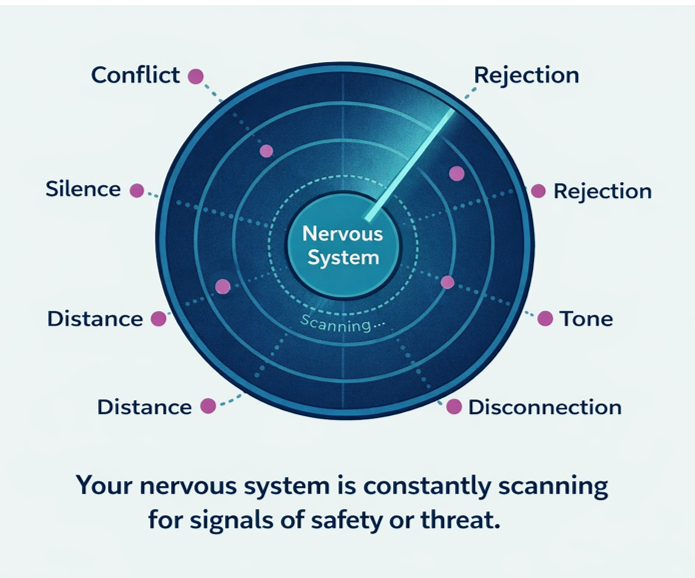
Your nervous system’s job is to constantly assess safety and danger and prepare your body to respond. If it detects a threat — whether real or perceived — it shifts your body into action to keep you safe. It’s making these assessments all the time, in every situation, whether you realize it or not.
Most of this process is automatic. You don’t get to decide what feels safe or threatening, and you can’t consciously turn the system on or off. Your nervous system is always taking in information from your environment and your relationships, picking up on cues that signal connection, risk, pain, loss, or instability. This happens very quickly. Your nervous system can assess a situation and activate your response in milliseconds.
A big part of how it does this is by shifting what’s called your state. State is the mode your system is operating in at a given moment. It’s the baseline that every experience is filtered through.
Calm. Anxious. Defensive. Overwhelmed. Shut down.
These aren’t just moods or feelings. They’re whole-body conditions that affect how you think, feel, and react.
How the Nervous System Is Calibrated
When you’re born, your nervous system is largely a blank slate. Over the first several years of life it calibrates itself through experiences and patterns, forming a foundational blueprint for connection, love, and relationships.
As a child, your system is learning one core thing: what it takes to stay connected to the people you depend on. Who shows up. Who doesn’t. What closeness feels like. What conflict leads to. Whether care is predictable, conditional, overwhelming, absent, or unsafe.
This learning happens long before language or conscious memory. Your body assumes from birth that the people you depend on for food, shelter, and survival love you. They draw the blueprint.
Unfortunately, we don’t get to choose who draws it. Some caregivers are loving and affectionate while others are neglectful or cause fear. If your early environment was chaotic or unstable, that also becomes part of the blueprint. Your nervous system adapts to the reality it’s in and assumes this is what love and safety look like.
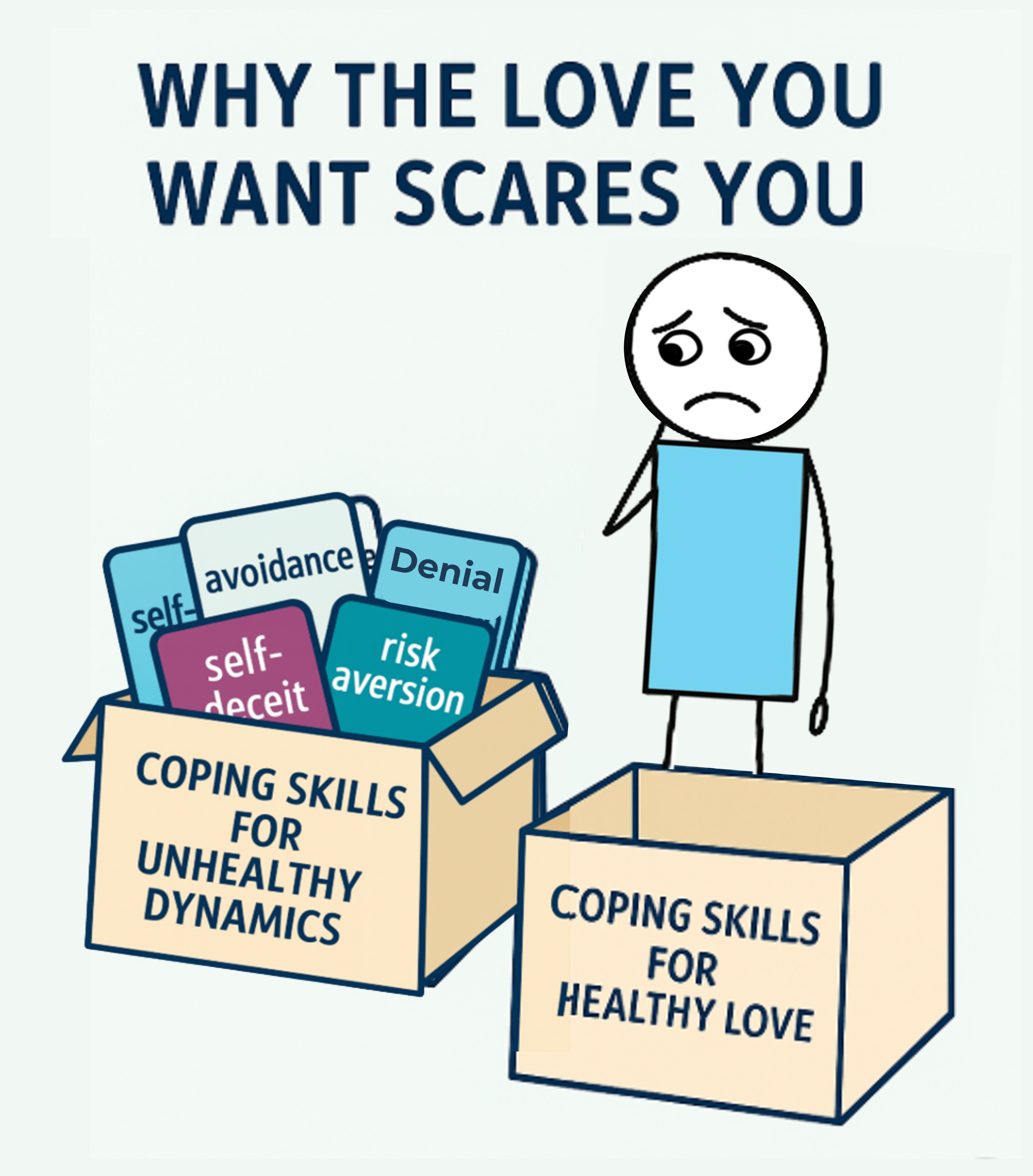
Once the blueprint is formed, you develop coping skills to help you feel safe. If being “good” and feeling loved was tied to pleasing, staying quiet, not having needs, or being useful, you adapted to become those things. That might mean staying out of sight, parenting your own parent, ignoring your needs, or being easy and agreeable. Those are your coping skills - the tools you use to navigate life.
This is where things start to go wrong.
Your nervous system doesn’t ask whether the current situation is healthy, fair, or good for you long term. It asks whether it matches something it already knows how to survive. If so, it thinks, “The blueprint says ‘We know this, we have a tool for it, let’s use it,’” and activates the old coping skills.
This is how coping skills that once kept you safe turn into defense mechanisms that still feel protective but now cause harm to you and the people around you. They create a sense of safety and stability, but they’re not real, and they often come at a high price.
If there is nothing like this on the blueprint, no tool for it in the toolbox, the nervous system considers it unfamiliar. It doesn’t know what this is, what to expect, or how to keep itself safe. Rather than chance it, your nervous system often rules it as potentially dangerous and sounds the alarm. Uncertainty and ambiguity can feel especially threatening because the system can’t predict the outcome.
How it Decides What’s Safe and What’s Not
You carry that blueprint with you for life, and your nervous system uses it constantly.
Not thoughtfully. Constantly.
Your nervous system wants to know if this is familiar, if it matches the blueprint. If so, it goes to the toolbox to grab the appropriate tool according to that now decades-old blueprint. Does this feel familiar? Does this resemble something that once led to closeness, rejection, conflict, or loss?
An unfamiliar situation isn’t necessarily dangerous. If the situation is objectively safe but the nervous system is treating it as a threat, it’s called a perceived threat. No real threat exists, but unfamiliarity can still create fear or discomfort.
In that case, your nervous system isn’t responding to objective reality. It’s responding to how the present moment lines up with your blueprint and earliest experiences. You were responding to what your nervous system expected to happen.
This process happens quickly, quietly, relentlessly, and often destructively. Unfortunately, the nervous system doesn’t explain itself. It just needs you to act.
How Our Nervous System (Mis)Communicates
Once your nervous system decides something feels unsafe, it needs you to act fast. It doesn’t have the luxury of explaining why, giving you context, weighing nuance, or walking you through its logic.
Your nervous system and your conscious mind are not equal partners. The nervous system makes the call, and it doesn’t trust your conscious mind to act fast enough or follow directions. When it believes safety is at stake, it bypasses your thinking and tells you what you need to hear to get you to comply. Instead of explaining what it’s reacting to, it delivers conclusions.
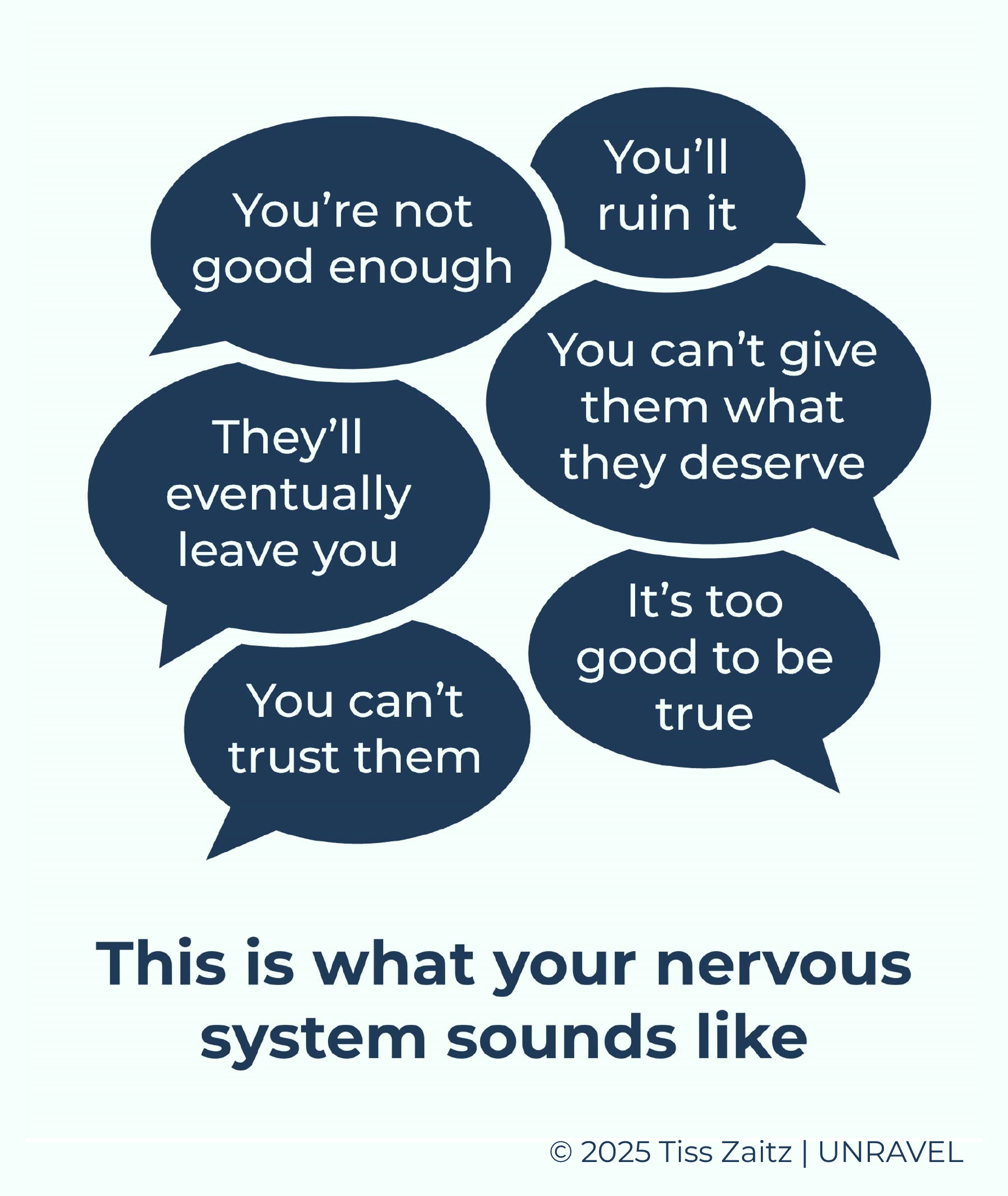
Instead of saying “This feels unsafe, it’s not familiar, I don’t have a tool for this,” it will say things like:
“I’m not good enough.”
“They’re pulling away.”
“They deserve better.”
“I’ll only hurt them.”
“They’re better off without me.”
“I can’t fix this.”
“It’s too late.”
And the worst part is that you will wholeheartedly believe them.
Your nervous system knows these messages are incredibly effective, especially if it’s been telling you some version of them your whole life. Early relationships may have taught you things like having needs is selfish, your feelings don’t matter, or your pain isn’t important. Those experiences make it much easier to believe the conclusions your nervous system delivers later.
So they feel like facts. They come with emotional intensity and a sense of certainty that’s hard to shake. Your nervous system doesn’t care if you’re happy or at peace. All it cares about is safety, and it needs you to believe the message so you’ll push away what it has deemed a threat, no matter how safe it actually is.
Sadly, logic rarely helps. You can know, intellectually, that this person genuinely loves you or that it’s okay to choose yourself. But feeling isn’t the same as knowing, and feelings run the show.
This miscommunication is one of the main reasons relationships become so painful. You’re not reacting to your current situation. You’re reacting to an outdated alarm system and a faulty autopilot.

What This All Means
Your nervous system used your earliest relationships to understand love and connection, and developed tools to feel safe when necessary. Protective strategies that once kept you safe can become rigid, automatic, and hard to override. They can make you resistant to change, quick to react, and stuck in patterns you don’t want. Those old tools can do more harm than good, but they’re still the only ones your nervous system has to work with. This is why people end up repeating the same relationship patterns, even when they desperately want something different.
That’s what creates self-sabotage. You push away or damage the love you want because if it’s unfamiliar, it doesn’t feel safe. Your nervous system convinces you it’ll end badly and you should get out before the other shoe drops.
The tragedy is that these patterns often create the very pain the nervous system is trying to avoid. Defenses meant to avoid abandonment can push people away and leave you feeling alone. Strategies meant to keep the peace can erase your needs and make love feel hollow. Attempts to feel safe can keep you locked in relationships that are unhealthy, unhappy, or unfulfilling.
If you recognize yourself in any of this, it doesn’t make you a bad person. This behavior is nervous-system-driven, not a moral failure or character flaw. You didn’t train your nervous system. You didn’t choose your internal wiring. This doesn’t excuse harm or make you the victim—you are still responsible for your actions—but it does explain it.
But Hope is Not Lost
Nervous system calibration isn’t permanent. It’s possible to update how it evaluates safety, learn to tolerate uncertainty, and build new tools. It starts with understanding what’s happening and giving yourself grace. You did the best you could with the tools you had. That doesn’t excuse harm, and you may have some repair to do, but using this as a judgment of your character or worth just fuels the cycle.
Understanding this and wanting to heal is where self-compassion becomes possible and shame starts to loosen its grip.

Want the newest UNRAVEL posts and updates delivered straight to your inbox?

I’m always looking to improve UNRAVEL. If something was confusing, missing, or especially helpful, please let me know.