
I think my relationship might be emotionally abusive or controlling.
First of all, what you’re feeling is real.
If you clicked on this Journey, you’re probably confused, overwhelmed, and starting to question yourself. You might be wondering: Am I making a big deal out of nothing? Is this really abuse?
That confusion isn’t accidental, it’s the goal. It’s tough to leave when you’re confused. You wouldn’t stay if you knew it was abusive and harmful. The only way to keep you there while being abusive is to mix in just enough good to give you hope and keep you guessing.
Part of the confusion is the gap between who they are in private versus around others. It can feel like Dr. Jekyll and Mr. Hyde. Everyone sees them as charming, thoughtful, generous, and easy going. Controlling or manipulative people are good at winning over friends and family, making it harder for others to see what’s actually happening. This can not only make you feel crazy, but it can also make you look unstable to others.
This Journey isn’t about labeling someone a monster or telling you what to do. It’s about helping you find clarity on what you’re experiencing and why it feels so confusing.
If it’s making you question yourself, tiptoe around their feelings, or tolerate hurtful behavior out of fear of making it worse, you’re not imagining things. This isn’t a matter of being too sensitive. This is unhealthy and abusive relationship behavior.
Not all difficult relationship behavior is coercive control.
Conflict, immaturity, poor communication, and emotional dysregulation can all create painful dynamics without necessarily being controlling or abusive. People can be reactive, defensive, emotionally immature, or overwhelmed without intentionally or systematically trying to dominate, isolate, or control the other person. (Learn more)
What distinguishes coercive control is not conflict itself, but the presence of repeated patterns that limit your autonomy, distort your reality, create fear, or make it harder for you to think, act, or choose freely.

But Emotional Abuse is Really, Really Hard to See.
Emotional abuse isn't something you can see, count, or measure. There are no bruises or broken bones. You can’t point to anything as being wrong. From the outside, it can look calm, normal, even good. An abusive partner may come across to others as thoughtful, funny, or easy to get along with. What’s happening behind closed doors doesn’t match what other people see, and sometimes it doesn’t fully make sense to you either.
It usually starts out as something small. A sarcastic comment that feels hurtful. A subtle shift in tone. A reaction that leaves you unsettled without quite knowing why. Maybe they seem distant or act irritated with you. You feel it, but when you ask what's wrong, they act like you're imagining it. It doesn't add up.
Part of what makes this so confusing is that these kinds of moments happen in all relationships. People get stressed, say things they don’t mean, misread each other, or have off days. The difference is frequency and reaction. In healthy relationships they don't happen often, and addressing them doesn't come with backlash.
With abusive relationships, these moments are increasingly common and leave you walking on eggshells. If you bring it up, you're made to feel crazy or like you're the problem. They act like you're making mountains out of molehills, but it’s their response that feels like an overreaction.
It's difficult to see emotional abuse because it's not some big painful ordeal - it's dozens of tiny ones. It gets confusing and makes you wonder if you're the problem - that you're too sensitive, overreacting, or reading into things that aren't there. You can't see their abuse because you're too busy trying to figure out how you're the one causing it.

How It Looks and Feels
You don’t wake up one day and realize you’ve lost yourself. It happens slowly, in ways that don’t seem like a big deal at the time.
When something feels off, even something small like their tone, a look, or a shift in energy, your nervous system picks up on it and tries to make sense of what’s happening.
First, you question the situation—why are they doing this? What did you do wrong? Where is this coming from? Then you question your reaction—are you being too sensitive? Are you overreacting? Eventually, you start to believe it’s your fault. If you had just said it better, softer, clearer, or not at all, maybe they wouldn’t have gotten upset.
So you start editing your words to avoid setting them off. You tell yourself they didn’t mean it like that. You get better at keeping the peace, even when it hurts.
You can say they hurt your feelings and explain how, but it won’t land. They tell you your feelings are wrong, and since there’s no way to prove their behavior caused it, you try to explain it better, calmer, more clearly.
What they did wrong isn’t even part of the conversation anymore. They successfully shifted the focus from them to you. You’re defending yourself to the person who hurt you, trying to prove you have a right to feel hurt.
Or maybe instead of shifting the focus, they give you a story or long explanation to justify their behavior. They have a reason for everything, and they don’t sound defensive, they sound certain. And it starts to make sense, so you accept their story.
Later, when you’re calm and thinking more clearly, that story doesn’t add up. You tell yourself it made sense when they said it, maybe you’re just not remembering it right. The truth is, you can’t figure it out because it never made sense to begin with.
Over time, the constant conflict wears you down, and eventually you just let things go. Not because anything gets resolved, but because you’re emotionally exhausted, and it doesn’t do any good anyway. Half the time it makes things worse. Conflict of any kind feels pointless, so you adapt your behavior in order to avoid it.
This keeps the peace and keeps the relationship stable, but it also enables the behavior to continue. They can now say and do what they want, even when it hurts you, because they’ve conditioned you to tolerate it.
None of this is random or accidental. This is how manipulation works.

But What’s Actually Happening?
When your feelings are hurt or you’re angry, your nervous system activation gets amplified.
Your thinking brain gets hijacked by your emotional brain. Logic gets blocked by emotions. You’re hurt, angry, nervous, but most of all confused. Your nervous system is desperate for relief. And the only person who can give you clarity is the same person who confused you in the first place.
Confusion is one of the most effective ways to control someone. If you can’t make sense of what’s happening, you can’t really make clear decisions about how to feel, what to think, or what to do. It’s paralyzing.
Wearing you down is another way to gain control. They get upset with you over the dumbest things. Sometimes it almost feels like they invent reasons to argue.
You ask them to vacuum, and the next thing you know, you’re fighting because the vacuum wasn’t in the right closet. The microwave breaks and it becomes a fight where you’re somehow to blame.
They knew where the vacuum was. They know you didn’t break the microwave. The fights themselves are unimportant, it’s that the fighting wears you down. It chips away at your self-worth.
They’re playing a long game.
Those constant arguments over minor things also gives them something valuable they want: control. For many people, the need to feel in control is their only way to feel safe and stable. When these arguments arise, it give them a sense of control.
“I can make you explain yourself for an hour.”
“I can make you feel anxious, apologetic, guilty, etc.”
“I get to decide how this evening is going to feel for you.”
These typically are not conscious thoughts, they probably have no clue this is what they’re doing. They just know this is how they feel like they have control over their life—by exerting control over you. And repetition of this make the control easier over time. They don’t just control how an argument goes and make sure they always win it, they’ve gotten you too scared to argue at all. They win.
When you’re living inside any of these patterns, you typically can’t see it. Not because you’re stubborn, blind, or making excuses for them, but because of something called fragmented memory.
Your brain learned a long time ago not to store similar negative events in the same place; instead, it stores them in pieces. Each instance gets compartmentalized into its own “box” in your memory. You can only evaluate them one at a time, so seeing how they all connect is nearly impossible.
Instead of seeing the pattern, you think this time is different. You find a way to rationalize it, blame yourself, or dismiss it as not a big deal. Nothing ever feels clear.
And when you can’t understand what’s happening, there’s nothing “wrong” to point to. Only a series of moments you can’t seem to make sense of.

Unhealthy relationships train you to adapt to harmful dynamics instead of challenging them or leaving.
You still love them… but how?
You know something isn’t right. You know you’re being hurt. But you still love them.
You’re not holding onto nothing, you’ve had real moments with them. Connection, closeness, times where it felt easy, natural, right. You’ve seen who they can be, and that version of them matters to you. The harmful version of them doesn’t erase the loving version.
So you rationalize. Maybe they didn’t mean it. Maybe they’re stressed. Maybe if you handle it better, it won’t keep happening. Because the alternative is harder to accept—that the person hurting you is who you’re in a relationship with, and the person you love has gone missing…again.
It creates cognitive dissonance: there’s something here worth holding onto, and something here that hurts.
You know they’re harming you now, but you remember how affectionate and loving they used to be. It can make you both confident that the love is there, while questioning everything.
Your happy experiences are real for you whether they were real for them or not. And that will always be true.
Why it’s so hard to leave
Even when the loving version of them comes back, it never stays very long. They’ll give you just enough love and affection to give you hope and make it even harder to walk away.
That’s the cycle, and it’s shocking how quickly and easily it can become the norm, often without you even realizing what’s happening.
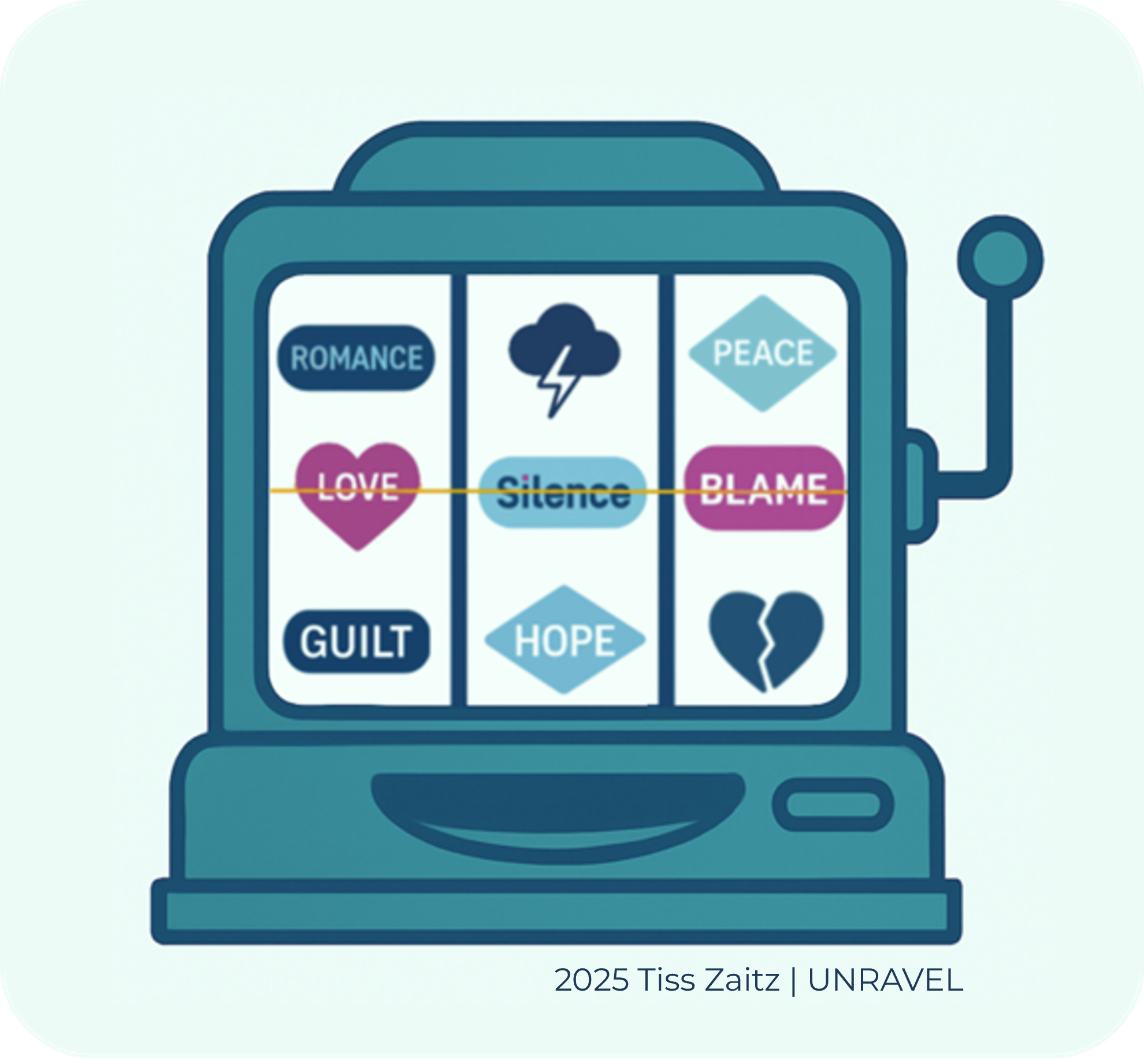
The brain is a prediction machine and hates uncertainty. When you never know what to expect or what might set them off, you can’t predict what happens or make sense of it when it happens. So your brain searches for answers, and it will usually find them, even if it has to manufacture them.
Intermittent reinforcement also works on your brains reward system. When they shift from devaluation to idealization, you get an intense dopamine surge, aka a reward. This trains your brain to seek those rewards; soon you’ll find yourself trying to “earn” their love and affection.
This turns anxiety and pain into a need to please, which makes you believe that leaving isn’t the answer, trying harder is.
And who benefits from this painful, emotional rollercoaster? Not you. You’re bending over backwards to keep them happy, while they hurt you and don’t even seem to care. And they more they hurt you, the harder you’ll work for the “reward.”
It sounds completely backwards and in some ways it is, but this is the way the emotional physics work and how they make leaving feel like emotional suicide, which makes the pain of staying seem like the lesser of two evils.
One of the strongest ways they create this cycle is called intermittent reinforcement. It’s a cycle with 2 stages: the happy days and the harmful days. The happy days are where they idealize you and put you on a pedestal. They’re happy, loving, affectionate, and seem excited about your future together. The harmful days are the opposite. They can be angry, argumentative, and confusing. The abrupt shift between the two can feel like emotional whiplash.
These hot-and-cold cycles are exactly what keeps you stuck. Casino slot machines are specifically designed using intermittent reinforcement cycles because it’s so effective. Gamblers have a hard time leaving a machine because they’ve won a handful of times, so any minute now they should win again. That’s how they work They pay out by design.

Love isn’t supposed to hurt like this.
Healthy relationships aren’t perfect. There will be conflict, hurt feelings, and missteps. But healthy conflict still feels safe.
You should never be afraid of your partner—physically or emotionally— or afraid to bring something up. You should never feel like you have to walk on eggshells to keep the peace. And you should never have to feel belittled. Saying angry things is one thing, but if your partner calls you awful, hurtful things, that is not love. That is abuse.
Conflict in healthy relationships gets resolved. Both parties are heard and treated with respect. There is accountability, repair, and a sense that both people are trying to understand each other. There may be anger and yelling, but not at a level that creates fear.
Love is not supposed to leave you confused, afraid, or emotionally exhausted. It is not supposed to make you feel small, insignificant, or cost you your sense of self. It should build you up, not tear you down.
This is not a rough patch, and it’s not you being too sensitive.
This is abuse. Period. And no matter how many times they promise, it’s unlikely to change.

You don’t have to be ready to act. You’re here, and that means you know something isn’t right and you’re trying to understand. That takes courage. And it’s more than most people in abusive relationships do.
What you’re feeling is completely valid, and what you’re doing is incredibly difficult and scary. Yet here you are.
You should be proud of yourself. This is strength.

Before you go…
I hope this journey gave you something useful—clarity, validation, maybe even a little relief from the confusion.
If you're feeling overwhelmed or unsure what comes next, that makes sense.
You're working through hard things.
If you want to keep going, UNRAVEL has more to offer:
The Foundations explain the mechanics of relationship behavior.
The Models & Frameworks show how those mechanics create the patterns people get stuck in.
Those pages take a slightly more educational approach.
But they’re still written in clear, everyday language.
No jargon. No 7 syllable words.
If you want to share your story, you can do that here.
Your experience matters.
Thank you for trusting me to guide you. I hope you find healthier, happier relationships ahead.

Every relationship is unique, and emotional harm doesn’t always follow the same patterns. What you’ve read here reflects common dynamics, but it’s not a diagnosis. I hope something resonated, but this content isn’t therapy or psychological, medical, or legal advice. It’s here to offer clarity, not conclusions.