Emotional Manipulation


What is Emotional Manipulation
Emotional manipulation is a form of psychological control that distorts your perception, erodes self-trust, and keeps you emotionally off balance. It’s less about one specific incident and more about a pattern of behaviors. It works by creating confusion, guilt, fear, self-doubt, or a sense of obligation that makes it harder to trust your own judgment. Over time, the focus moves away from what happened and onto managing the other person’s emotions, reactions, or approval.
Some tactics are obvious, like threats, blame, or pressure. Others are far more subtle. A comment that makes you question your memory. Affection that appears intensely, then disappears just as quickly. Promises about the future that keep you invested but never materialize. Repeated redirection that turns every conversation away from the original issue and back onto you.
What makes emotional manipulation so difficult to recognize is that it often doesn’t feel like manipulation in the moment. It can feel like conflict, misunderstanding, insecurity, passion, or even love. The result is often the same: you begin second-guessing yourself, minimizing your own needs, or staying invested in patterns that leave you confused and emotionally off balance.
Confusion is the goal. When you’re confused, you’re less likely to leave because you aren’t quite certain if it’s them or you, if it’s really as bad as you think, or if there’s a reason for it that can be fixed—and people don’t leave relationships until they’re certain it’s the right move. Confusion keeps you from that certainty so they can continue to abuse you. If you’re stuck because you’re trying to understand what’s happening and why, you’re unlikely to find an answer.
They’re confusing on purpose. They want you to be confused. They need you to be confused. That’s the answer.
What is a Red Flag?
A red flag is an early warning sign that something may be off in the relationship or that this person may become harmful over time. It is not automatic proof that the relationship is unhealthy; it’s something to make a mental note of and pay attention to moving forward. Everyone makes mistakes, things come out wrong, and people have bad days. We all have red flags. Isolated instances are human and while they should not be ignored or dismissed, what matters is whether or not it becomes a pattern, escalates over time, or shows up alongside other concerning behaviors.
How they respond to you being hurt or calling out bad behavior can be a pretty big clue. If they don’t take you seriously, mock your feelings, or shift the blame to you, this is a fairly serious red flag. If they react this way once or twice, its a red flag to make note of. If it becomes a pattern, then you have a problem. And it doesn’t take 15 instances to be a pattern, 3 or 4 instances of the same hurtful behavior across a few months is a pattern.
The point of a red flag is not to sound an alarm and cause panic. It does automatically mean you need to end the relationship. It’s a warning. It means pay closer attention and proceed with caution. Not all warnings lead to danger, but you can’t ignore them. When a pattern of red flags becomes apparent, it’s time to reconsider how healthy this relationship might be.
Seeing the warning signs of emotional manipulation can be tough. Manipulative behavior is often disguised are love, flattery, or logic. It doesn’t look like manipulation in the beginning. And ‘logic’ isn’t always what it seems. Below are 2 tables that break down common emotional manipulation tactics, the effects they tend to have, and what they often sound like in real life. More detailed information about how they work and what to look for is listed below the tables. You can jump to those by clicking below.
Gaslighting | Love Bombing | Intermittent Reinforcement | Trauma Bond
Guilt Tripping | Silent Treatment | Emotional Blackmail
Blame Shifting | Projection | Deflection
Isolation | Triangulation | Future Faking
Hovering | Weaponized Incompetence | Weaponized Ignorance
Double Standards | Dehumanization / Objectification | Resource Control
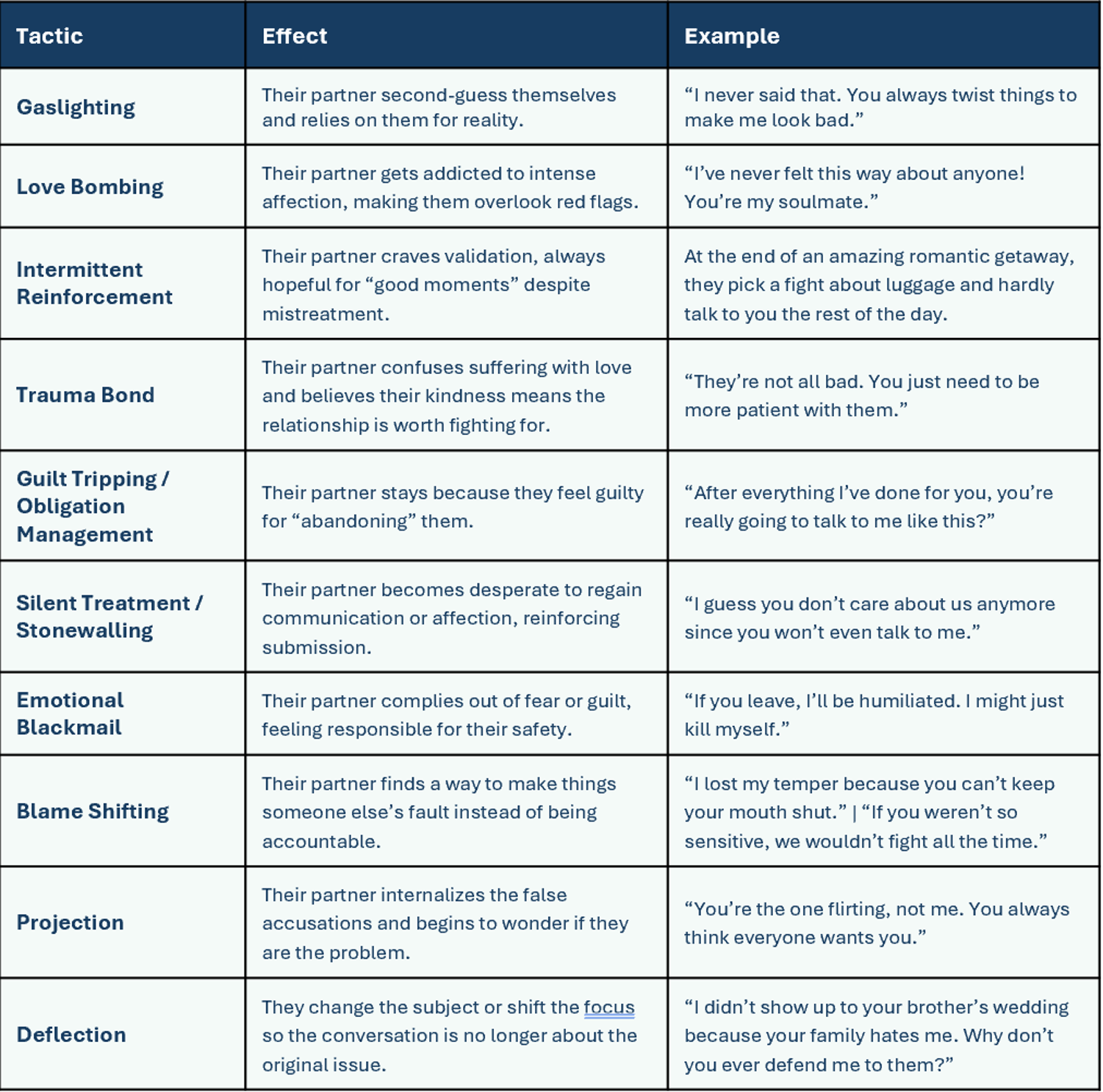
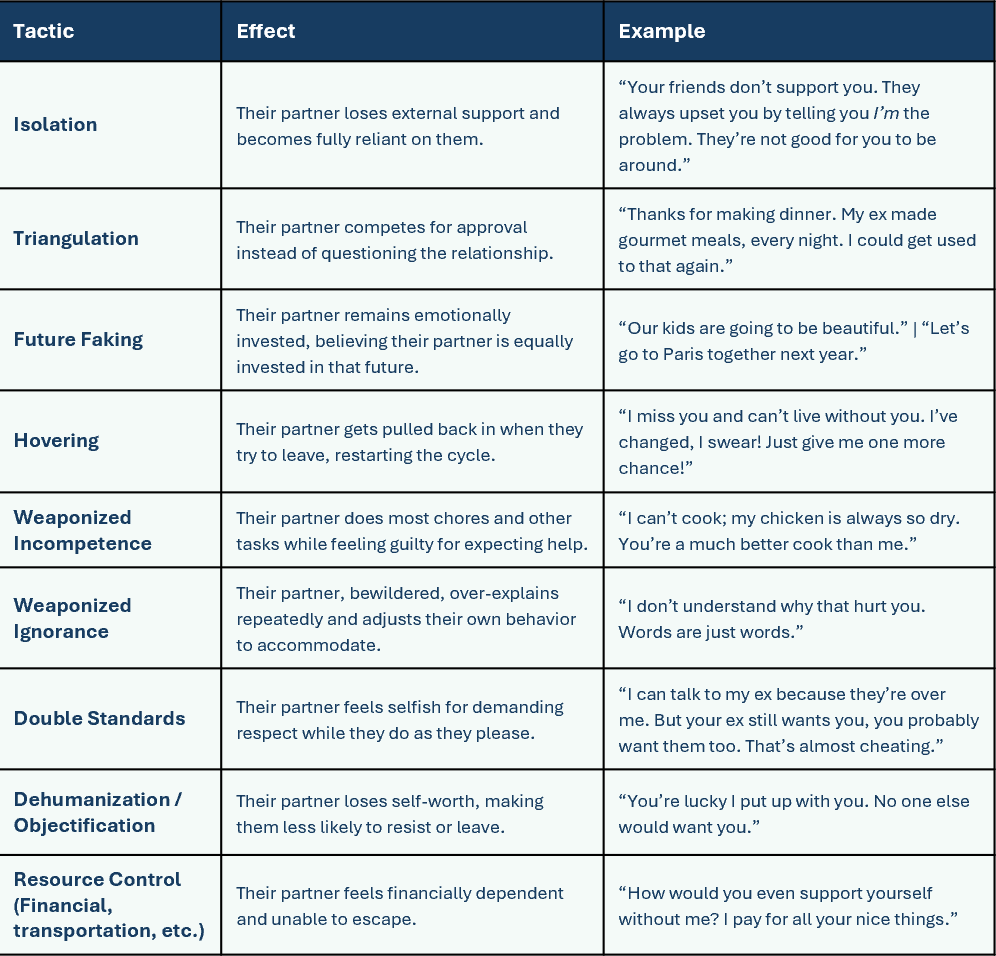
*Adapted from the author’s published thesis research on emotional manipulation tactics.

Think you understand emotional manipulation?
Take this quiz to see how much you understand tactics like gaslighting, love bombing, and emotional blackmail.
(Most people score lower than they expect.)


The tables above are meant for quick reference and examples. The sections below go a step further, breaking down how each tactic works, what it often feels like on the receiving end, and why these patterns can be difficult to recognize while you’re in them.
Emotional Manipulation Glossary
Gaslighting
Gaslighting is a form of emotional manipulation that gradually makes you question your own mind. It works by denying what happened, rewriting how something happened, or dismissing your emotional reaction to it. Instead of addressing the issue itself, the focus shifts to whether you are remembering it wrong, overreacting, being too sensitive, or making something out of nothing. Over time, the damage is not just confusion about the event — it is a growing loss of trust in your own judgment.
This is what makes gaslighting so destabilizing. The goal is not simply to win an argument. The real effect is that your internal sense of reality starts to weaken. You begin checking your memory against theirs, doubting your emotional responses, and eventually relying on their version of events more than your own. The longer it continues, the more it can distort not only your perception of what happened, but your confidence in yourself. What begins as confusion often becomes self-doubt, guilt, and a slow erosion of emotional clarity.
*There are many forms of gaslighting. There is no obvious “red flag” in the words they use. “You said to be ready by 6p” can be gaslighting if used to distort your reality.
Love Bombing
Love bombing is an intense rush of affection, attention, validation, and emotional closeness that happens very quickly, often early in a relationship. On the surface, it can look like chemistry, deep connection, or finally feeling truly seen. What makes it different is the speed and intensity. The relationship may feel unusually fast-moving, deeply intimate right away, or emotionally “all in” before trust has had time to build naturally.
What makes love bombing so powerful is that it creates attachment before there is enough information to accurately assess the relationship. The emotional high can make later red flags easier to dismiss because your mind keeps referencing how good it felt in the beginning. That early intensity often becomes the emotional anchor people keep trying to get back to, even after the relationship shifts into confusion, inconsistency, or control. The initial closeness was not the relationship itself — it often becomes the hook that keeps you invested in the hope that the beginning will come back.
Intermittent Reinforcement
Intermittent reinforcement is one of the most psychologically powerful forms of emotional manipulation because of its inconsistency and unpredictability. Periods of warmth, affection, or validation are interrupted by distance, criticism, conflict, or withdrawal, often for seemingly little or no reason. The brain likes certainty and predictability. Intermittent reinforcement gives neither. This is what makes it all so confusing.
The good moments make the relationship feel real, hopeful, and worth fighting for. The painful moments create confusion, anxiety, and a drive to figure out what changed, and why. It’s emotional whiplash. When you don’t know what sets them off, you start to walk on eggshells. When you don’t know what will bring back connection, you bend over backwards to win them back. It’s hard to leave because you know the good is there. You get just enough hope to keep you from giving up.
Trauma Bonds
A trauma bond is a powerful emotional attachment that forms through repeated cycles of emotional pain and emotional relief (intermittent reinforcement). It often develops in relationships where hurt, fear, criticism, or control are repeatedly followed by moments of warmth, apology, affection, or reconnection. Over time, the bond becomes tied not just to the good moments, but to the cycle itself.
What makes trauma bonds so confusing is that what feels like depth, love, or meaning is often intensity + smoke and mirrors. That intensity creates a strong emotional pull toward the relationship, even when it is causing significant harm.
Trauma bonds activate reward and dependency pathways in the brain in ways that closely resemble drug addiction. They form a strong dependency because the person causing the pain and anxiety is also the only person who can relieve it. This is why people often stay even when they know they’re being abused. The connection can be so strong that leaving can feel more painful than the abuse itself.

Guilt Tripping / Obligation Management
Guilt tripping and obligation management work by making you feel responsible for the other person’s feelings, reactions, or well-being. Instead of staying focused on the original issue, the conversation shifts toward what your actions are supposedly doing to them. Over time, this creates pressure to put their emotions ahead of your own needs, boundaries, or perspective.
Obligation can also make you feel like you can’t leave, that you committed so now you’re obligated to stay. The result is often self-silencing, overexplaining, or agreeing to things that do not feel right because saying no starts to feel selfish, cruel, or disloyal. Guilt and obligation are some of the most common reasons people stay in relationships, and they cause some of the most damage. It just delays it.
The delayed, long-term damage is that both partners lost confidence and self-worth and likely end up feeling unfulfilled, and resentful. Regret is common with staying out of guilt or obligation.
Silent Treatment / Stonewalling
The silent treatment and stonewalling involve withdrawing communication, affection, or responsiveness in a way that creates confusion, distance, and emotional pressure. It’s used to punish, avoid accountability, or force the other person to back down. Over time, it can train you to walk on eggshells and to not raise concerns, express needs, or address conflict, because doing so will be met with silence, withdrawal, or emotional shutdown. The result is anxiety, self-censorship, and a growing fear of saying or doing the wrong thing.
Emotional Blackmail
Emotional blackmail uses fear, obligation, guilt (FOG) or threats to control your behavior and force compliance. Common signs include ultimatums, excessive guilt-tripping, silent treatment, and playing the victim to get their way. It often stems from the manipulator's need for control, insecurity, or lack of empathy. The message is that if you do not comply, there will be emotional consequences: anger, withdrawal, blame, self-victimization, or the implication that you are responsible for what happens next. Over time, this creates a sense that saying no is dangerous, cruel, or too costly, making it harder to trust your own boundaries and decisions
One of the more common examples is threatening to harm or kill themselves if you leave them. No one wants to feel responsible for that (even though you absolutely are not and would not be responsible for anything they choose to do to themselves) which makes it terrifying to leave. That’s what makes it effective.
Blame Shifting
Blame shifting redirects responsibility away from the person who caused harm and places it onto your reaction, your needs, or your behavior. Instead of addressing what happened, the focus becomes what you did wrong, how you brought it up, or why you “made” them respond that way. Over time, this can leave you feeling responsible for problems you did not create and make it harder to hold onto a clear sense of what actually happened.
Projection
Projection happens when someone attributes their own thoughts, motives, feelings, or behavior to you instead of owning it themselves. For example, dishonesty may be reframed as you being untrustworthy, or their hostility may be cast as your aggression. This shifts attention away from their behavior and puts you in the position of defending yourself. Over time, it can create confusion, self-doubt, and a distorted sense that you are the source of the very dynamics they are creating.
Deflection
Deflection shifts the focus away from the original issue and onto something else entirely. They change the subject or turn things around on you, and before you know it, the conversation is no longer about what they did. They got the spotlight off of them so they can avoid being held accountable for their behavior.
A lot of times they put you on the defensive. Instead of addressing the concern you raised, the conversation gets redirected to your tone, a past mistake, or another conflict. Over time, this makes it difficult to resolve problems because the real issue is never actually addressed. The result is often confusion, circular conversations, and a growing sense that every discussion somehow ends up being about you instead.
Isolation
Isolation gradually weakens your connection to outside sources of support, perspective, and reality-checking. This can happen through direct discouragement, criticism of your friends or family, creating conflict around your outside relationships, or making it feel easier to withdraw than deal with the fallout.
It can also be the need to constantly defend your partner to your friends and family creates friction and distance. One or both sides gets angry or worn out and pulls away.
Over time, your world can become smaller and more centered around the relationship, which makes it harder to trust your own perspective. No longer having outside opinions or views to consider, you to become increasingly reliant on your partner for emotional support, validation, and reality.
Triangulation
Triangulation brings a third person—real or implied—into the dynamic in a way that creates pressure, comparison, insecurity, or divided loyalties. This can look like comparing you to an ex, invoking friends or family to validate their position, or suggesting that “everyone else” sees the problem the same way they do. The goal is often to shift the balance of power, make you question yourself, or increase competition for approval, attention, or reassurance.
Future Faking
Future faking uses promises about the future to keep you emotionally invested in the present. Change, commitment, effort, or a better version of the relationship is always just around the corner—after this stressful period, after work calms down, after one more conversation. This could be explicit promises or just mentions of when you’re married, your future kids, etc. These don’t “promise” that future, but it make you feel they imagine that future with you.
The promised future keeps hope alive and can make it easier to tolerate current pain, inconsistency, or unmet needs. Over time, you may find yourself staying connected to the potential of the relationship rather than the reality of how it consistently feels.
Hovering
Hovering happens when someone reappears just as you begin to gain distance, clarity, or emotional stability. This can look like a sudden message, apology, check-in, or gesture that pulls you back into the dynamic without any real change in the underlying pattern. The timing is often what makes it powerful: it interrupts your healing and reactivates hope, guilt, or attachment right as you were beginning to detach. Over time, it can keep the cycle going by making separation feel temporary and unfinished.
Weaponized Incompetence
Weaponized incompetence happens when someone repeatedly acts unable, confused, or “just bad” at basic responsibilities in a way that shifts the burden onto you. Tasks, emotional labor, planning, or follow-through somehow end up becoming your job because it feels easier than dealing with the mistakes, excuses, or repeated failures. Over time, this can create resentment, exhaustion, and an unequal dynamic where you are carrying far more of the practical and emotional load of the relationship.
Weaponized Ignorance
Weaponized ignorance happens when someone repeatedly claims not to understand seemingly basic things. They don’t understand why something hurt you, crossed a boundary, or created a problem, even it’s something obvious that even a child understands, even after it has been clearly explained multiple times.
The issue stops being the behavior itself and becomes your job to keep explaining, justifying, and proving why it mattered. They understand, they just want you to exhaust yourself so you’ll stop bringing things up. Over time, this can make you doubt whether your feelings are reasonable, while allowing the same behavior to continue without real accountability or change.