
Social Scripts

What are Social Scripts?
Human beings grow up surrounded by ideas about how life and relationships are supposed to work. Some of these ideas are stated directly. Most are not. They show up through family dynamics, cultural expectations, religion, media, peer groups, and the examples people see around them.
Over time, these messages form an internal rulebook — a set of assumptions about what love should look like, what a “good partner” does, when major life milestones should happen, and what staying in or leaving a relationship means. Psychologists often refer to these unwritten expectations as social scripts.
Social scripts shape far more than small social interactions. They influence major life decisions — when people believe they should commit, what they tolerate, what they hide from others (or even from themselves), and what they believe their choices say about them. They can shape what someone thinks they deserve in a relationship or whether they believe they are good enough for someone else.
Most people are not consciously aware these scripts exist. They just feel like reality — the way life and relationships are supposed to work. In practice, many people are following a rulebook they didn’t write and don’t even realize they’re holding.
Because these scripts are tied to identity and self-worth, falling outside the expected script can trigger powerful emotions — shame, pressure, comparison, and the fear of being seen as a failure. Feeling “behind,” staying longer than someone wants to, or rushing decisions that don’t feel right often has less to do with the relationship itself and more to do with the script someone believes they’re supposed to be living.
Examples:
“Love means sacrifice.”
“If it’s the right person, it should feel effortless.”
“Jealousy means you care.”
“Conflict means the relationship is in danger.”
“A good man never leaves a good woman.”
“Keep the peace at all costs.”
Where Social Scripts Come From
No one sits people down and hands them a list of relationship rules. Social scripts develop gradually through the environments people grow up in and the messages they absorb along the way.
Families are often the first place these scripts take shape. Children watch how the adults around them handle conflict, commitment, loyalty, affection, and separation. They see what is praised, what is criticized, and what is quietly avoided. Even when no one explains the rules out loud, the patterns become clear.
Culture reinforces those patterns. Movies, television, social media, religion, and community norms all send messages about what relationships should look like and how life is supposed to unfold. These narratives shape expectations about everything from who people should date to when they should marry, how couples should divide responsibilities, and what it means to be a “good” partner.
Friend groups add another layer. Every social circle develops its own unspoken norms — what kinds of relationships people admire, what choices get questioned, and what behavior is quietly expected. Over time, those expectations become part of the social environment people are navigating.
No one wrote these rules down. They develop gradually through shared expectations and repeated patterns. But once they exist, they tend to reinforce themselves. Following the script is usually rewarded with approval and belonging. Deviating from it can bring questions, criticism, or quiet judgment.
Over time, that reinforcement can make scripts feel less like social expectations and more like reality — even when the rules themselves are arbitrary, outdated, or unfair.

Common Types of Social Scripts
Social scripts can influence almost every part of how people approach relationships and life decisions. Some are subtle and personal, shaped by a particular family or social circle. Others are so common they feel like universal truths.
Most people are following several of these scripts at the same time. They shape expectations about timing, roles, loyalty, success, and what a “normal” relationship is supposed to look like. When someone’s life aligns with these expectations, it usually feels comfortable and socially supported. When it doesn’t, the pressure and judgment described earlier often start to appear.
Below are some of the most common relationship scripts people absorb without realizing it.
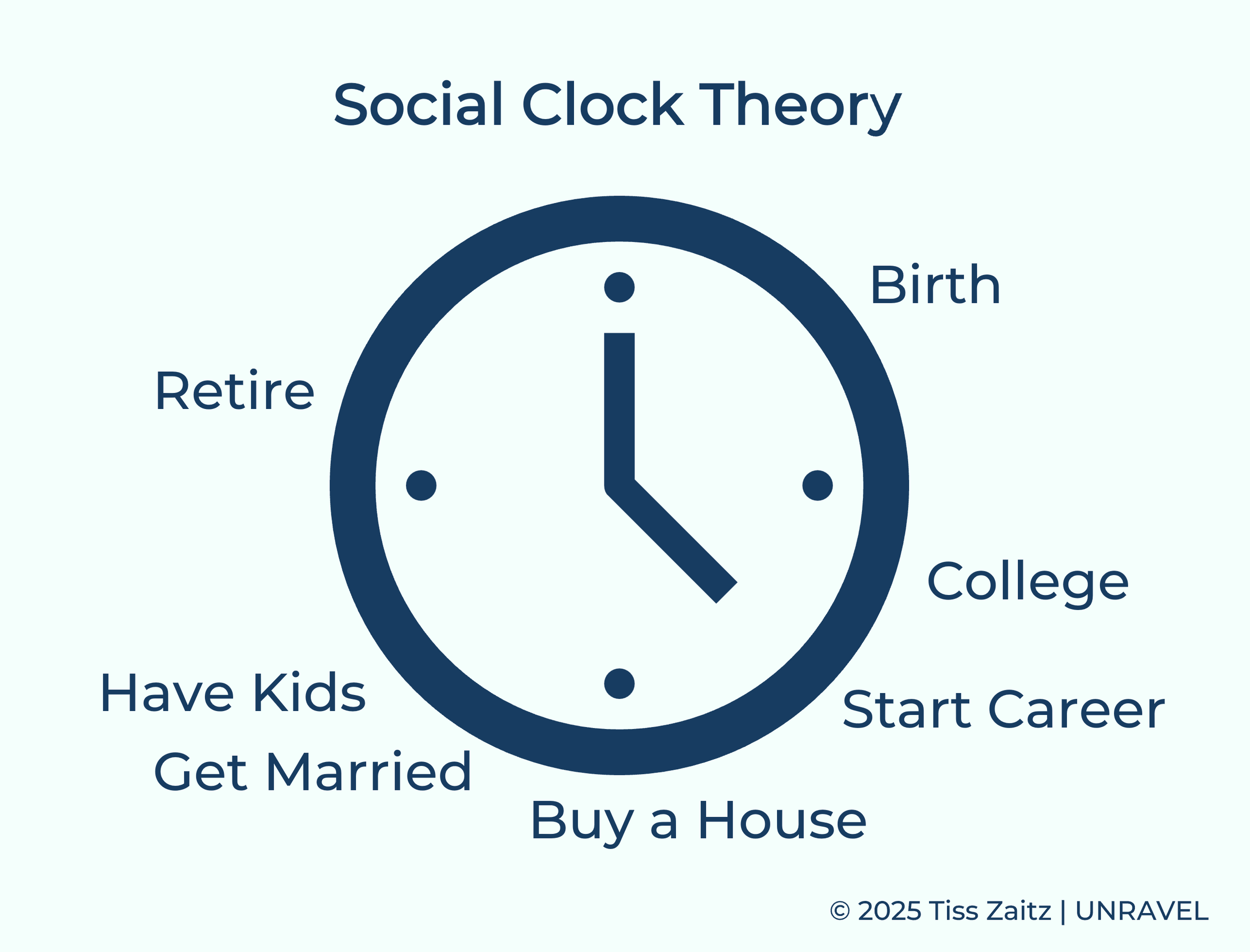
Life Timeline Scripts (Social Clock Theory)
Many people believe they are making deeply personal life decisions when they are actually responding to powerful social expectations.
Most cultures carry an informal sequence of milestones people are expected to follow: finish school, establish a career, find a partner, marry, buy a home, have children. The specific timing varies, but the underlying message is the same. Life is supposed to progress in a certain order and at a certain pace.
When someone’s life follows this timeline, it is rarely questioned. When it doesn’t, people often start to feel like they are falling behind.
This is where the pressure begins to show up. Friends get engaged. Social media fills with weddings and pregnancy announcements. Family members start asking questions. Over time it can create the sense that something is wrong or that time is running out. For some, it can feel like their life is a failure.
The script itself is rarely examined. It just feels like the way life works.
One important exception involves women who want biological children. Unlike most social timelines, fertility does create a real biological window. That reality can add another layer of pressure to the timeline script. Fear of missing the opportunity to have children can lead to many of the same outcomes discussed earlier, including making relationship decisions someone might not otherwise have made.
Relationship Role Scripts
Many people carry strong assumptions about what each partner is supposed to do in a relationship.
These expectations can involve practical responsibilities, such as who earns money, who manages the household, and who takes care of children. But they often extend much further. They can shape beliefs about who should initiate conversations, who should compromise, who should keep the peace, and who is responsible for maintaining the emotional health of the relationship.
Because these expectations are usually unspoken, people often assume they are obvious or universal. When a partner doesn’t follow the same script, it can feel confusing or unfair.
Over time, these scripts can create patterns that people mistake for personality. Someone who constantly avoids conflict may be described as “easygoing.” Someone who manages everyone’s emotions may be labeled “highly empathic” or “overbearing.” In many cases, these are learned behaviors shaped by the roles someone believes they are supposed to play.
Loyalty Scripts
Another powerful set of scripts centers on what loyalty is supposed to look like.
Many people grow up with the belief that loyalty means staying no matter what. Real commitment is seen as enduring hardship, sacrificing personal needs, and proving dedication through persistence. Within this script, leaving a relationship can feel like betrayal, failure, or giving up too easily.
This belief can make it difficult for people to evaluate their situations clearly. Someone may stay in an unhappy or unhealthy relationship not because they want to, but because leaving feels like violating an important moral rule.
Loyalty scripts can also shape how outsiders judge a relationship. A partner who stays may be praised for their devotion even if they secretly feel unfulfilled. Someone who leaves, even for valid reasons, may be viewed as selfish or disloyal. Someone who speaks an uncomfortable truth may be seen as causing problems or hurting people.
Commitment and loyalty can be meaningful parts of a healthy relationship when they are authentic. But when they are driven by external expectations rather than genuine choice, they can cause harm.
Success and Failure Scripts
Social scripts don’t just define what relationships should look like. They can also define success and failure, and become a measure of someone’s self-worth.
When a relationship ends, the script often frames it as a failure. People may feel pressure to explain what went wrong, assign blame, or prove that the time invested was not “wasted.” Someone who leaves may worry about being seen as the person who ruined something that was supposed to last.
Some people also internalize the idea that a failed relationship means they themselves have failed. That belief can make it difficult to leave even when they know they are unhappy.
When success is defined by maintaining the relationship at all costs, it becomes harder to evaluate the relationship itself. Instead of asking whether the relationship is healthy, fulfilling, or right for the people involved, the focus shifts to maintaining appearances.